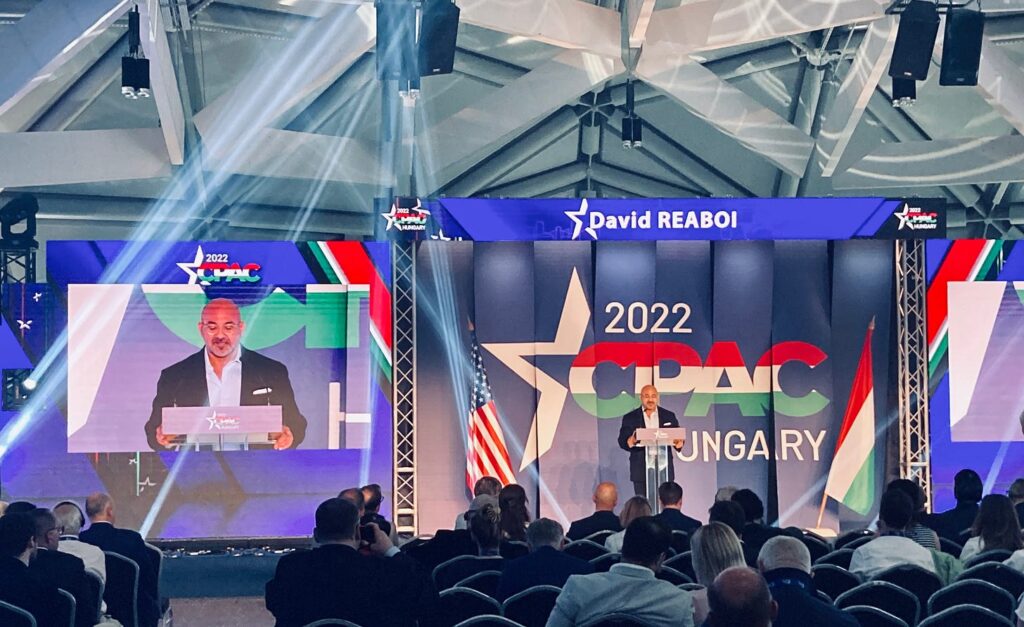
Last week, I had the privilege of attending and speaking at the first CPAC in Budapest, sponsored by the Centre for Fundamental Rights (az Alapjogokért Központ), one of the most prominent conservative think tanks in Hungary. The text and video of my speech follows.
I had the honor of working for the Hungarian government as their registered lobbyist in the United States, mostly dealing with American media and trying to get the Hungarian point of view out into the political conversation.
It was particularly rewarding, too, considering my background. I was born in New Jersey, where my parents had met after immigrating to America in the 1960s from Romania. They were both Jews from Transylvania – my mom from Koloszvar, my dad from Satmar – and their primary language, as well as those of their parents, was Hungarian.
And so, at my wonderful grandmother’s insistence, Hungarian was the first language I learned at home. After my first day in nursery school, I came home confused. I told my parents that, “ezek a gyerekek nem is tudnak magyarul beszélni.” I was exasperated that “These kids don’t even know how to speak Hungarian!” Grandma assured my parents that, living in the United States, I’d learn English soon enough, and she was right.
Now I need a lot more practice, so I hope I’ll be returning to this great country more frequently. Being here feels like home – just like going to a Hungarian bakery in Florida feels like home; just like hearing Hungarian spoken in the street feels like home.
As I was returning here, I began to think about this more. Even as my family is Jewish and from Romania, our love of the Hungarian language – even expressed in such a rudimentary form, with only an instinctive grasp on the language’s famously-complicated grammar – is probably why we’ve always considered ourselves Hungarians.
After all: Romania was a place where my family had lived, but I’ve never thought of myself as Romanian. As a Jew, Israel is very significant, both religiously and politically, but I don’t speak Hebrew, despite years of lessons in school – and that adds a bit of distance.
This helped me understand that language is perhaps the most crucial way of tying one to a culture and to a nation. Because it is a small country with a unique language, Hungarians understand this link acutely.
The nation exists in physical form; it is a place you can live and visit. But it is only land and buildings, not so different from the land and buildings in neighboring countries. History is important but, for most people, the details of ancient history come and go. Culture also waxes and wanes, as new tastes and traditions sometimes replace the old. All these things can disappear or fade away.
But the Hungarian language cannot disappear, because with it, so will the conception of the unique Hungarian nation apart from its neighbors. It is the key that unlocks reverence for culture and understanding of history that passes from one generation to the next, over a thousand years.
So it is not at all surprising that this country – with a language that is constantly endangered, due to size and demographic trends – has had leaders who have committed themselves to its defense.
Prime Minister Orban and his government has stood up to some in the EU, the US and other neoliberal or globalist forces and said no. To his great credit, he understands that Hungary cannot afford mass immigration from waves of foreigners with no ties to the country, no real way to integrate, and no understanding of the language.
In most of my dealings with Hungarian government officials, at some point someone says, “this isn’t the United States; Hungary is a small country.” Its population is about 10 million. Ethnologue estimated that there are roughly 3 million native Hungarian speakers outside the country. This isn’t an endangered population, thank G-d, but its leaders need to be mindful of the dangers.
Hungary’s political leadership understands that globalism is the enemy of particularity, of uniqueness. Aside from the economic effects, the kind of connectedness that comes from mass technology was promised as a great opening, allowing people across the world to meet and converse with others, first through email and the internet and now with social media.
There are civilizational and political effects, too. As we are brought closer together, we become the same: similar values, similar politics. For more populous countries and more widespread languages, this seems like a great deal. For smaller countries, it is also a danger. There is a politics and a worldview that comes along with this connectedness, and it is left-wing, and uses the power of social media to constantly radicalize.
We see it most clearly with issues of free expression, which they believe should be severely limited to outlaw what they consider “disinformation” that challenges their worldview. Also, we see it in the obsession with new, radical identities, based on race and now gender. The horrific sexualization of children is a part of the left’s fulfillment and manifestation of its ideology when it comes to gender and sexuality.
Other speakers here will detail how effective Hungary has been in combating these trends, which emerge from globalism and this new connectedness. But Hungary’s successes – even just speaking about them forthrightly – have enraged many. And Hungary’s enemies are quite formidable.
Hungary’s situation in the United States is interesting – challenging, but I believe it is hopeful. First, the challenges.
Those who many have quite correctly called “globalists” – for decades, we used to call them “liberal internationalists” or “Left- or Right-Wilsonians” – attack Hungary for defending, above all, its sovereignty and defense of its efforts at national survival. They are hostile to any of these initiatives, as they are completely absorbed with understanding the world only through allegations of racism or other prejudices.
Maintaining a sovereign, traditionally-minded country with a language and culture seems like the most heinous of crimes. It is being, as they say, “on the wrong side of history” which, in the Left’s persistent understanding, being opposed to the great homogenization of values.
These people fill the ranks of the State Department, Congressional committee staff and now the White House. They are pushed by a massive, multibillion dollar industry of interconnected far-Left NGOs – I call it the “NGO Archipelago” – that serve as outside pressure groups. All these people are interchangeable, and move from one part of the ecosystem to another seamlessly.
I’ve written a book about how governments, NGOs and think tanks work together to create content for the media – often, this means creating whole outlets and journalistic “beats” that can influence the tone of coverage of a particular topic. That has created a negative hysteria about Hungary that influences the political class.
There is a bright side and, as is so often the case, it is the common sense of the American people themselves. A growing number of conservatives in the US now see Hungary as an example, thanks largely to US-based writers and opinion-makers who have taken trips here, become acquainted with the Hungarian government, and look to its successes in maintaining a modern western country that protects its language, history and people.
Hungary’s vigorous, unapologetic defense of these things – especially when it comes to doing real, tangible things, such as passing laws – is a great contrast to the failures to do the same in America’ elected representatives.
It could not be more significant that this appreciation for Hungary has not come from above: it did not come from politicians who built alliances with one another and dragged intellectuals, media people, and others along. We in the commentary class see Hungary as a kind of model precisely because our American leaders have failed.
For most of the last half-century, the leaders of the American conservative movement have been timid about the use of state power for noble, conservative ends. They were libertarians and neoconservatives who, for different reasons, believed that common culture, language and demographics were important to the nation’s survival – but, importantly, felt that these things should never be protected with the power of government.
That might work while there is widespread agreement about these things, but in a time when every media, education, big business, big tech, and every other power center has been captured by a radicalism that believes its opponents must be silenced, timidity in the face of that challenge is certain defeat.
In the words of William F Buckley, the conservative’s job was “standing athwart History, yelling stop” – vigorously arguing against History, which they acknowledge is shifting ever leftward, unavoidably. For two generations, America’s conservative politicians embraced this thinking. Many still do, and we on the New Right are enthusiastically working to replace them – or to get them to “know what time it is.” Because the hour is late.
We see Hungary as the best example of how to maintain freedom for its citizens while protecting the traditional basis for the nation – G-d, nation and family – doing it unapologetically and succeeding.
Originally published at Late Republic Nonsense.