So earlier this week I released a new book. (It’s available now in paperback and on Kindle.) The publication represents the end of a journey: the piece began in Spring, tormenting me as it changed shape with the seasons—from a book chapter to a magazine article to a report to, finally (and inevitably), a beautifully-put-together little book. Wrestling with the writing, research, and release of what became The Epstein Conspiracy accompanied me through what has, so far, been the most consequential year of my life.
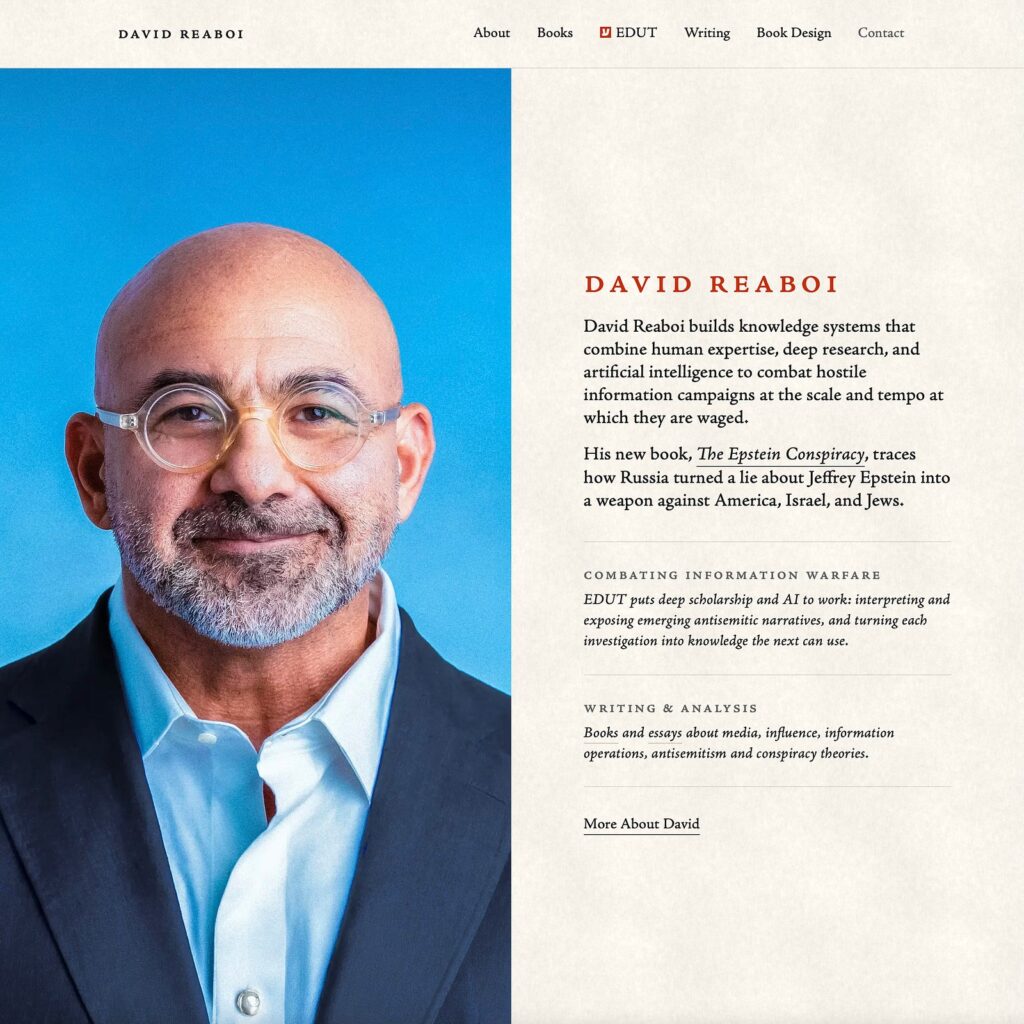
I only decided to release this book a few weeks ago. And, as I was getting it ready for publication, I also built myself a new website from scratch—which, if I can say so myself, is the best-looking site of its kind. I had some decent headshots taken, for the first time in my life. I’m so proud of the aesthetics and the way the content is arranged; it’s really some of my best work. You can find it, of course, at davereaboi.com.
Why build a personal website, though, in 2026?
Among its myriad other destructive features (such as the damage to attention spans, credulity, interpersonal dynamics, and reasoning), the constant churn of the social media timeline has disfigured our ideas of memory and permanence. And, as poisonous social media networks have crowded out everything else in our online lives, it became clear that we were losing some of the things we used to take for granted about the early promise of the internet. Chief among these, I think, is maybe the most basic thing humans have focused on since we began writing: the ability to archive and organize content in a predictable place.
We humans are synthesizing creatures, coming to conclusions about things based on thought and observation of what’s in front of us. And we can’t help but do it; the pace and deliberateness of that process, however, is crucial. If the timeline transforms everything into pieces of “content,” we lose the context necessary to truly make sense of it in the first place. As a practical matter, we’re forced to search and to collate ourselves—and that’s only if we know what we’re searching for and make a very deliberate effort to do so.
The consequences for public understanding are worse. The timeline advantages those who promote falsity, destruction, and negativity. Lies thrive amid content shuffling on and off the timeline every 24 hours, like a drive-by shooting. The next time they appear, whatever correction was offered has vanished into the churn. Truth is always more complicated, however; it requires consistency and the ability to justify one’s position or to illustrate the historical record. All this is to say, I strongly believe that—at least for the causes that I devote my life and energy towards—the future of effective communications is outside the timeline.
What interests me is what happens when intellectual work is allowed to accumulate. A piece of research should leave us better equipped to understand the next development, and an argument should remain available to be examined and improved. Someone arriving at a subject for the first time should be able to enter a world of existing knowledge, rather than reconstruct it from whatever happens to cross his screen. I’d spent years thinking about how to create those conditions; recently, though, I began to see how I could actually create them.
Finding My Life’s Work
There’s something else about the website, though, that’s a far bigger deal than it might otherwise seem.
I’m going to be a bit honest here—which necessarily means I’ll be a bit vulnerable. Over the last several years, as I have approached 50, I’d become increasingly unsure of my professional direction: while I’ve been blessed with the ability to do a variety of things, sometimes that, too, can be a curse. It’s difficult to define and work towards a future where you can be one of three or five different things. People would ask what I do, and I became increasingly unsure of what to tell them. Because I didn’t really know myself. What finally made it unbearable was that I was unsatisfied with all of it, for one reason or another.
After October 7, 2023, that uncertainty acquired a particular urgency. I wanted to contribute something meaningful to the Jewish People, but I couldn’t see clearly what that contribution should be. I remember asking G-d to point me towards something I could do with the talents I’d been given—something useful and meaningful, drawing on what was distinctively mine to offer.
Things began to change several months ago, when I began thinking about using AI in ways that seemed unique. Even as I was fumbling around, making mistakes, and learning how to use it, I began to have ideas about how to apply it to concepts and problems that I’d spent years trying to solve. In no time, it was clear that what I was moving towards was the culmination of the last twenty years of thinking deeply about and working in national security, communications, and (especially) institutional dynamics.
It took a little while for me to realize what was happening. Was I building a single, big project to address one problem—or was I developing something like a methodology that was much bigger than that?
What made the larger possibility real was devising a system architecture around someone else. I realized that I’d hit upon something unique. I began with the questions that mattered to her, the distinctions she made, and the work she wanted to do. Then I worked out how a substantial body of research could be organized and developed around that intellectual direction—bringing new material into conversation with her ideas, exposing disagreements, and helping her produce work she could not have produced as readily before.
It was beautiful in a remarkable way that I hadn’t really appreciated or encountered before—unlike music or film or art, which exist as objects, it was a working system of 1s and 0s that nevertheless reflected the unique experience, passion, and creativity of the person for whom it was created.
I was more proud of that concept than of anything else I could think of, and the potential to refine and build on it seemed endless. With every day, this becomes more clear and exciting. In trying to understand someone else’s undertaking well enough to create something for it, I discovered a kind of work that belonged to me. This, finally, was what I needed to be doing, especially for causes and people who are close to my heart. For the first time in my life, I saw myself contentedly spending the rest of my career mining this one beautiful patch of earth.
Perhaps that’s part of why finishing this particular book has meant so much: while I was finding the right form for that piece, I was finding a form for my identity. This short book embodies the things that give me the most pride in anything I make: it is true, well-written, and beautifully packaged. I want to get the substance right, express it with clarity and force, and give it a physical form worthy of the care that went into it. To hold all three together in one finished thing is satisfying in a way I wish more people could experience.
What has come together in my life in the last month has been truly remarkable—not just this realization, but about 20 other things, as well. The pure joy that accrued suddenly is something that I’m still amazed by. It does feel as if I was given, in the middl’est of middle age, the most exquisite gift. And—as small and insignificant as a bio on a personal website usually is—in my case, now, it’s symbolic of finally feeling at home.
Originally published at Late Republic Nonsense.